Agentic Commerce Is Here – How to Get the LLMs to Recommend Your Brand
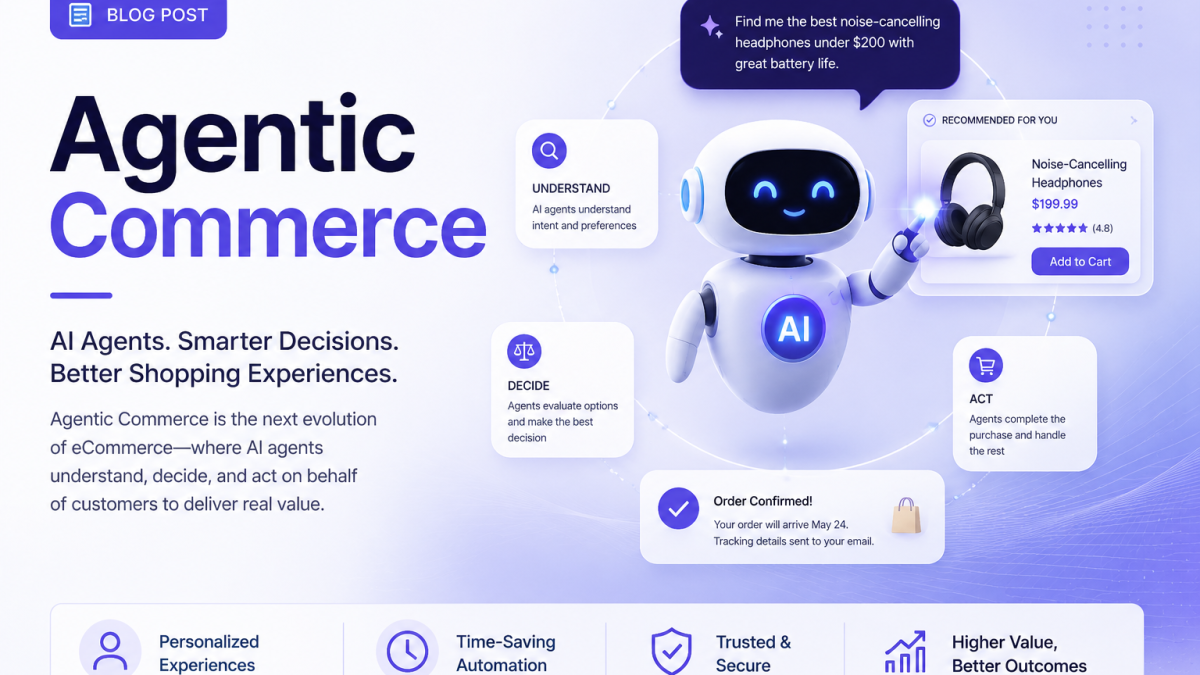
Now is the time to optimize your brand for ChatGPT, Claude, and Gemini.
Agentic Commerce Just Had Its Biggest Week Yet. Here’s What Actually Happened.
Shopify turned on Agentic Storefronts for every merchant. OpenAI killed Instant Checkout and rebuilt shopping from scratch. Meta announced AI-powered creator commerce at ShopTalk. And Klaviyo shipped 75+ updates pushing toward autonomous marketing. Here’s what it all means for e-commerce brands—and what you should actually do about it.
We wrote about the Universal Commerce Protocol back in January when Google and Shopify announced it at NRF. At the time, we said agentic shopping was a platform shift and brands needed to start preparing.
That was four months ago. Things have moved faster than we expected.
In the span of a single week, Shopify flipped the switch on agentic storefronts for millions of merchants, OpenAI admitted its first approach to in-chat shopping failed and launched a completely different model, Meta laid out its vision for collapsing the entire purchase funnel inside its platforms, and Klaviyo signaled that retention marketing is going autonomous.
We’re tracking all of it. Here’s the breakdown. (P.S. – CLICK HERE for a free audit and how your brand can improve its LLM rankings).
Shopify Turned On Agentic Storefronts for Everyone
This is the big one.
Shopify launched Agentic Storefronts—and they’re now on by default for every merchant on the platform. Your Shopify product catalog automatically syndicates to ChatGPT, Microsoft Copilot, Google’s AI Mode, and the Gemini app. Shoppers can find your products, compare them, and buy them without ever leaving the AI conversation.
That’s not a beta. That’s not “coming soon.” It’s live. See it in action:
Shopify’s VP of Product Mani Fazeli broke it down: millions of merchants can now sell inside ChatGPT in the US. Merchants keep full control over product pages, checkout, and customer data. The way he framed it—AI is “a new front door to commerce” with Shopify handling the infrastructure behind it.
They also launched a new Agentic Plan for brands that don’t even have a Shopify store.
- No monthly subscription.
- You only pay standard card processing rates when something actually sells.
- Add your products, sync them to AI channels, and you’re live.
As Shopify’s official account put it: “set up once, sell everywhere.”
The Universal Commerce Protocol we covered in January now has backing from Walmart, Target, Etsy, American Express, Mastercard, Stripe, and Visa. Meta checkout integration via UCP is coming soon.
Why this matters: Shopify isn’t positioning itself as a website builder that also does AI. It’s positioning itself as the commerce infrastructure layer that powers transactions wherever AI agents operate. That’s a fundamentally different business—and it changes what it means to “have a Shopify store.”
OpenAI Killed Instant Checkout. What Replaced It Is More Interesting.
Here’s a part of the story that didn’t get enough attention. OpenAI launched Instant Checkout inside ChatGPT back in September 2025. The idea was simple: users could buy products from retailers directly in the chat. No leaving the conversation.
It flopped. According to CNBC, only about 30 merchants ever went live. OpenAI quietly removed the feature on March 4, 2026. But they didn’t give up on shopping; they pivoted.
| Instant Checkout (The Old Approach) | Product Discovery (The New Approach) |
| Focus: In-chat transactions and checkout. | Focus: Discovery, comparison, and recommendation. |
| Issues: Struggled with real-time inventory, sales tax calculations, and inaccurate pricing from web scraping. | Features: Side-by-side product comparisons, image-based visual search, and conversational filtering. |
| End Result: Users buy directly in ChatGPT (Failed). | End Result: Sends users to the retailer’s own app, website, or payment flow to buy (Succeeding). |
OpenAI also co-developed a new Agentic Commerce Protocol with Stripe that lets merchants plug their product catalogs and promotions directly into ChatGPT. Target, Sephora, Nordstrom, and Home Depot are already on board. Walmart launched an in-app ChatGPT experience that connects to their loyalty program and Walmart Pay.
The shift: OpenAI learned the hard way that owning the transaction is really, really hard. Inventory, pricing, tax, loyalty programs, returns—retailers have spent decades building that infrastructure. What AI is actually good at is the discovery and recommendation layer. That’s where the value is.
This matters for e-commerce brands because it means the winning strategy isn’t “hope ChatGPT handles your checkout.” It’s making sure your product data is clean enough that AI agents recommend you in the first place—and then having a checkout experience worth sending people to.
Meta Wants to Collapse the Entire Purchase Funnel
At ShopTalk, Meta made its own play. Jason Yim, who works in client solutions at Meta, laid out the thesis:
“For years, the journey was fragmented. See an ad, go to a website, add to cart, maybe buy. Now, we’re collapsing that funnel with AI and creators.”
The specific announcement: creators can now earn directly through AI-assisted commerce flows on Meta’s platforms. Discovery, recommendation, and purchase all happening inside Instagram and Facebook—without the user ever leaving to visit your website.
If you’re running Meta ads, pay attention to this. It changes the game in a few ways:
- Campaign structures optimized for driving traffic to external landing pages may become less important than campaigns optimized for in-platform conversion.
- Product feed quality inside Meta’s catalog becomes as important as your PDP.
- Creator partnerships aren’t just a brand awareness play anymore—they’re a direct sales channel integrated with AI-powered recommendations.
Combined with Meta’s GEM algorithm update (which we covered in February), the entire Meta advertising ecosystem is being rebuilt around AI. Creative is targeting. The funnel is collapsing. And the brands that understand this shift early will have a real advantage.
Klaviyo Is Pushing Toward Autonomous Marketing
This one flew under the radar, but it’s directionally important.
Klaviyo shipped 75+ product updates in Q1, and the framing they chose was deliberate. Not “easier.” Not “faster.” The word they used was autonomous—”designed to make building connection, delivering support, and driving performance easier and more autonomous.”
For brands running lifecycle marketing through Klaviyo, the implication is clear: the platform is building toward AI-driven flow optimization, segmentation, and personalization that requires less manual intervention.
- Flows that optimize their own send times.
- Segments that build themselves based on behavioral patterns.
- Personalization that adapts per recipient without someone manually setting up conditional splits.
Zoom out and you can see the whole picture coming together: AI agents handle product discovery (Shopify + ChatGPT), AI collapses the purchase funnel (Meta + creators), and AI automates post-purchase nurturing (Klaviyo). The amount of human orchestration required at each step is shrinking.
The Skeptic’s Case (And Why You Should Listen)
Not everyone’s buying this.
Eric Seufert—one of the sharpest analysts covering advertising and commerce—has been consistently arguing that agentic commerce has a structural problem most people are ignoring.
His argument: the entire concept violates the motivations of the platforms that actually control commerce. Amazon wants to own the customer relationship and monetize first-party data through advertising. Shopify wants to be the commerce layer. Why would either of them yield the discovery experience to a third party like ChatGPT that disintermediates them from their users?
And he’s got receipts:
- Amazon’s Rufus already influenced 40% of holiday transactions.
- Walmart built Sparky.
- OpenAI’s Instant Checkout failed with only 30 merchants.
- Independent agentic checkout experiments showed 3x worse conversion rates than traditional retail paths.
Seufert’s thesis: if agentic commerce becomes a real consumer behavior, it’ll be captured by Amazon and Walmart, not by ChatGPT. The incumbents always win platform shifts when they control the inventory, the logistics, and the customer relationship.
Our take: He’s probably right about who wins the transaction layer—OpenAI already proved that. But the discovery and recommendation layer is a different story. When someone asks ChatGPT “what’s the best protein powder for women over 40” and your brand shows up with a detailed, data-rich product listing and strong reviews, that’s a new customer who may never have found you through a Google search or Meta ad.
You don’t need to bet your business on agentic commerce. You need to make sure you’re visible when the agents go looking.
But we know Shopify is bullish on this. As is ChatGPT (and soon Claude and Gemini). Skate to where the puck is going. Look at what Shopify’s President had to say:
What E-Commerce Brands Should Actually Do Right Now
Here’s the practical playbook. We’ve been implementing this with clients since the UCP announcement in January.
1. Fix Your Product Data (This Week)
Every single one of these announcements depends on structured, accurate, rich product data. AI agents can’t recommend products with thin descriptions, missing specs, or generic titles. If your Shopify product title says “Reset Kit” instead of “5-Day Protein-Forward Gut Health Reset | 15 Meals Included,” you’re invisible to every AI agent shopping for your category.
Do this now: Audit every product title, description, and attribute in your catalog. Write them for machines as much as for humans. Include specific data—nutritional info, use cases, ingredient highlights, comparison points.
2. Implement Schema Markup
Google’s AI Mode, ChatGPT’s product recommendations, and Copilot’s shopping features all pull from structured data. Product schema with reviews, pricing, and availability makes your products parseable by AI agents. FAQPage schema makes your brand citable by LLMs. This was already important for SEO. It’s now a prerequisite for showing up in AI-mediated shopping.
3. Build Your Knowledge Base
Shopify’s Agentic Storefronts include a Knowledge Base app that lets you control how your brand and product information appears in AI responses. Think of it as a sales script for an AI agent that’s going to represent your brand in millions of conversations. Cover your product FAQs, return policies, ingredient sourcing, brand story, competitive differentiators. Be specific. Be comprehensive. Update it monthly.
4. Don’t Abandon Your Website
Seufert is right about one thing: the platforms that control discovery will optimize for their own interests, not yours. Your website, your email list, your direct customer relationships—those are still your most defensible assets. Invest in agentic readiness as a low-cost, high-optionality play. But don’t redirect budget away from channels that are actually driving revenue today. The smart move is being visible everywhere AI agents look while maintaining direct relationships with your customers.
5. Your Content Strategy Now Serves Double Duty
Meta’s creator commerce play, plus the way LLMs evaluate and recommend brands, means your content strategy isn’t just about organic traffic anymore. It’s building the citation network that AI agents reference when deciding what to recommend. YouTube videos, expert-authored blog posts, Reddit discussions, review aggregation—all of this feeds the AI layer. Invest in content that’s data-backed, authored by credentialed experts, and structured for both humans and machines.
The Bottom Line
Agentic commerce had its most consequential week yet. Shopify shipped the infrastructure. OpenAI learned from its mistakes and rebuilt around discovery. Meta is collapsing the funnel. Klaviyo is automating the lifecycle. And smart skeptics are reminding everyone that the transaction layer is still the retailers’ to own.
For e-commerce brands, the playbook isn’t to panic or pivot. It’s to get your product data, structured markup, and brand knowledge base ready so that when AI agents go shopping on behalf of your customers, your products are what they find.
The cost of getting ready is low. The cost of being invisible to the next generation of product discovery is not.
FAQ
Is agentic commerce actually driving sales yet?
It’s early. Microsoft says shoppers using Copilot are 194% more likely to complete purchases when purchase intent is present. AI-driven orders grew 15x in 2025. But OpenAI’s Instant Checkout failure shows that the technology for in-chat transactions isn’t mature. Right now, the real value is in AI-powered product discovery that drives users to your checkout—not replacing your checkout entirely.
Do I need to do anything to activate Shopify’s Agentic Storefronts?
No. If you’re on Shopify, Agentic Storefronts are enabled by default. Your products are already being syndicated to ChatGPT and other AI platforms. But “being syndicated” and “being recommended” are two different things. The brands with clean, detailed product data and strong reviews will get surfaced. Everyone else will get skipped.
Should I sign up for Shopify’s Agentic Plan if I’m not on Shopify?
If you’re already selling on another platform and want to test AI shopping channels without migrating, it’s worth exploring. There’s no monthly fee—you only pay processing rates when something sells. Low risk, potentially high signal about how AI agents interact with your products.
What’s the most important thing I can do right now?
Audit your product data. This is the single highest-leverage action because it benefits every AI channel simultaneously—Shopify’s Agentic Storefronts, Google’s AI Mode, ChatGPT’s shopping features, and Copilot’s checkout. Rich, structured, accurate product data is the foundation everything else is built on.
Is Eric Seufert right that agentic commerce is a “collective hallucination”?
He’s right that owning the transaction layer is incredibly hard—OpenAI proved that. But the discovery layer is a different story. LLMs are already influencing how people research and choose products. The brands that are optimized for AI-powered discovery are getting in front of customers they wouldn’t have reached otherwise. You don’t need to believe in fully autonomous AI shopping to benefit from making your brand visible to AI agents.
At Wallaroo Media, we’ve been building agentic commerce readiness into our client work since the UCP launch in January. If you need help with product data optimization, schema implementation, LLMO, or figuring out where agentic commerce fits in your overall marketing strategy—let’s talk.