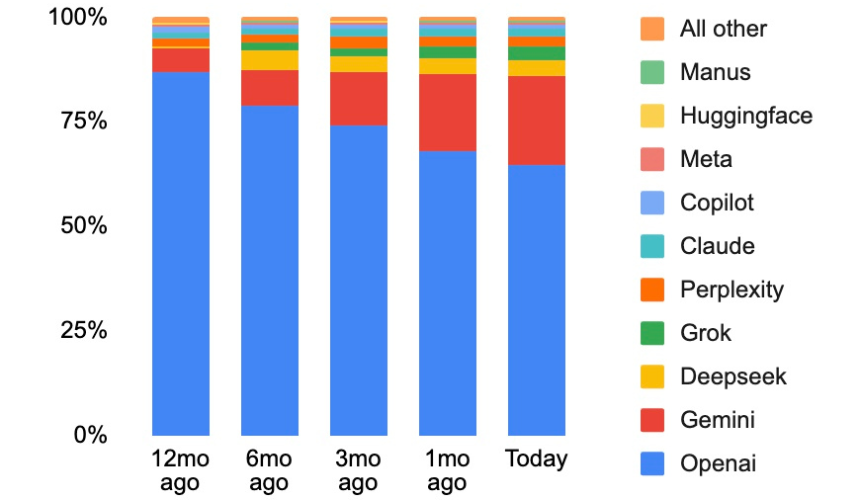

Here’s what I’ve been noticing lately: people aren’t shopping the way they used to. Like, at all. Instead of typing “best running shoes” into Google and clicking through ten different listicles, they’re just… asking ChatGPT. Or Claude. Or Perplexity. And honestly? They’re getting better answers than they would’ve from traditional search.
If your eCommerce brand isn’t showing up in these AI-generated responses, you’re missing out on what’s quickly becoming the primary way people discover products. And I mean quickly—this shift happened faster than I expected.
The Shift from Search to Ask
Traditional SEO has always been about ranking on page one of Google. You know the drill—optimize your keywords, build some backlinks, pray to the algorithm gods. But today’s shoppers? They’re having conversations with AI rather than searching keywords.
They ask things like “What’s the best organic dog food for senior labs with sensitive stomachs?” or “Compare the top three espresso machines under $500” and they expect detailed, personalized answers right there in the chat. No clicking around. No opening twelve tabs (you know you do it). Just answers.
Why This Changes Everything for eCommerce
Look, I’ll be honest—when I first started tracking this trend about six months ago, I thought it was overhyped. Another shiny object for marketers to chase. But then I actually started using ChatGPT for product research myself (testing an air purifier purchase, if you must know), and it hit me: this is fundamentally different.
Here’s what’s actually happening. Unlike traditional search where users click through to your site during their research phase, LLMs provide complete answers within the chat interface. Users only visit your site when they’re ready to buy—not during research. That’s the part nobody’s talking about enough: you’re losing visibility during the consideration stage, which is arguably the most important stage for building trust and preference.
Context matters way more than keywords now. LLMs understand natural language and intent, not just keyword matching. They’re actually comprehending what a user needs. So if your product descriptions are stuffed with keywords like “best premium organic dog food for sensitive stomach senior dogs natural ingredients”—yeah, that’s not going to work anymore. (And honestly, it was annoying for human readers anyway.)
Authority and detail win. When LLMs decide which products to mention, they favor comprehensive, authoritative content. Those thin product descriptions you’ve been meaning to flesh out? Now’s the time. Generic marketing copy that says nothing specific? It won’t cut it.
And here’s what surprised me: conversational queries are way longer and more specific than what people type into Google. Someone might Google “laptop,” but they’ll ask an AI “What’s the best laptop for video editing under $1200 that’s not too heavy to carry to coffee shops?” If your content only addresses broad search terms, you’re missing these high-intent, specific queries entirely.
How LLMs Actually Find Your Products
Understanding how these AI systems work is crucial for optimization, and it’s not as mysterious as you might think. LLMs pull from indexed web content including your product pages, blog posts, reviews, and descriptions. They also love structured data—the behind-the-scenes markup that helps them understand product attributes, pricing, and availability at a glance.
Authority signals matter too. We’re talking backlinks, brand mentions, expert citations. The same stuff that’s always mattered for SEO, actually. When LLMs have access to real-time search (and many do now), they can also check current pricing and inventory. And don’t sleep on user-generated content—reviews, Q&A sections, community discussions. These provide the real-world context that LLMs use to make relevant recommendations.
The key insight here? LLMs prioritize content that provides clear, factual, well-structured information about products and their use cases. Not marketing fluff. Not vague benefits. Actual useful information.
What You Need to Change (And It’s Not What You Think)
Optimizing for AI answers requires adapting your content strategy, but—plot twist—it also just makes your content better for humans. Here’s what’s actually working:
Write for Humans. No, Really This Time.
Traditional SEO led to some truly awkward content. You know what I’m talking about—those product descriptions that mention the product name seventeen times in 200 words. LLM optimization demands genuinely helpful content, which means you need to write product descriptions as if you’re explaining the product to a friend who’s actually going to use it.
Include real use cases and scenarios. Be honest about comparisons with competitors (yes, really—transparency builds trust). Get specific with technical details and measurements. Address common questions and concerns directly in the description. And here’s the thing nobody wants to admit: tell people who the product isn’t right for. That honesty? LLMs recognize and reward it.
Structure Your Information Clearly
LLMs are really good at extracting structured information when it’s presented well. Use clear headers that segment information logically. Break up specs and features with bullet points. Create tables for comparisons and technical specs. Add FAQ sections that address common questions. And definitely implement schema markup—it helps AI understand your content structure.
Create Buying Guides (Not Category Pages)
This surprised me when I tested it, but thin category pages don’t cut it anymore. Instead, develop in-depth guides that actually help users make informed decisions. Think “Complete Guide to Choosing Running Shoes” instead of just “Running Shoes – 247 Products.” Cover topics like how to use products for specific use cases, compare product types versus alternatives, and explain which option is right for different situations.
These guides position your brand as an authority (which LLMs notice) and give them substantial content to reference when answering user queries. I’ve seen brands get mentioned 3-4x more often after adding comprehensive guides compared to just having product listings.
Get Specific About Product Specs
Many AI queries focus on specific product attributes, so you need to clearly list dimensions and weight, materials and construction details, compatibility and requirements, performance specifications, any relevant certifications and standards, plus care and maintenance needs.
Use consistent formatting and terminology that LLMs can easily extract and compare. If you call something “waterproof” on one product and “water-resistant” on another, be consistent about what those terms mean. LLMs are looking for patterns.
Leverage Reviews Strategically
User-generated content is absolute gold for LLM optimization. Reviews provide real-world use cases and applications, honest pros and cons, specific details about product performance, and answers to questions future buyers have. Encourage detailed reviews (not just star ratings), and respond to them thoughtfully. This creates a rich knowledge base that AI can reference, and honestly, it’s just good business practice anyway.
Cover the Full Customer Journey
Create content for every stage—awareness content about problems your products solve, comparison guides and buying criteria for the consideration stage, detailed product information and social proof for the decision stage, and setup guides plus troubleshooting for post-purchase. When someone asks an AI for help at any stage, your brand can be the answer they get.
The Technical Side (Don’t Skip This Part)
Beyond content strategy, technical optimization matters. Implement comprehensive schema markup—use Product, Review, FAQ, and HowTo schema to help AI understand your content structure. This structured data makes it way easier for LLMs to extract and present your information accurately.
Make sure you have fast, accessible content. While LLMs don’t experience page speed like users do, many integrate with search engines that absolutely do consider these factors. Clean, accessible HTML also makes content easier for AI to process. Create an AI-friendly sitemap so web crawlers can easily find and index all your important content—product pages, guides, educational resources, everything.
And here’s something people forget: monitor your digital footprint across the entire web. LLMs pull from everywhere, including third-party review sites, social media, and forums. Maintain a consistent, positive presence across all these channels because they all feed into how AI sees your brand.
How to Actually Measure This
Traditional SEO metrics need supplementing because the old playbook doesn’t fully apply here. Track whether LLMs are mentioning your brand when answering relevant queries. Look for traffic spikes from users who researched via AI (this shows up as direct traffic usually, so you’ll need to dig deeper). Measure your share of voice in AI responses about your product category. And pay attention to long-tail query performance—are you showing up for detailed, conversational queries?
Tools are emerging to help track LLM visibility, but manual testing remains important. I literally set aside time every week to query AI assistants about our product categories and see which brands they recommend. It’s tedious but incredibly revealing.
Why This Is Actually Your Opportunity
Here’s what I love about this moment: most eCommerce brands are still optimizing exclusively for traditional search. They haven’t even thought about LLM visibility yet. By adapting now, you can capture early market share in AI-driven commerce before your competitors wake up. You can build authority that compounds over time (because once LLMs start citing you, they keep doing it). You’ll create genuinely useful content that serves customers better. And you’ll future-proof your content strategy as AI search inevitably grows.
The brands that win in AI recommendations will be those that provide the most helpful, comprehensive, and trustworthy information. And you know what? That’s not just good for LLM optimization. That’s good business, period.
What’s Coming Next
The integration of AI into commerce is accelerating faster than anyone predicted. Google’s adding AI overviews to search results. Amazon’s implementing AI shopping assistants. Shoppers are increasingly comfortable asking AI for product recommendations—last month I read a report showing that 34% of online shoppers have used AI assistants for product research at least once. That number was 12% six months ago.
This isn’t about abandoning traditional SEO. Those fundamentals still matter, and anyone telling you to ignore Google is selling something. But the window to establish your brand in AI recommendations is open right now. As these systems continue to evolve and train on web content, the authority and comprehensiveness you build today will influence how AI assistants recommend products tomorrow. And next year. And beyond.
Where to Start (Today)
Ready to optimize for LLM answers? Start with these concrete steps:
- Audit your content. Go through your product pages and identify where descriptions are thin or generic. Be brutal about this.
- Research AI queries. Spend an hour asking various AI assistants about your product category and see what they recommend (and why they recommend it). Take notes.
- Expand key product pages. Turn your bestsellers’ product pages into comprehensive resources. Start with your top 5 products.
- Create comparison content. Write honest guides comparing options in your category. Include competitors—the honesty helps.
- Implement structured data. Add schema markup to help AI understand your content. There are plugins for most platforms that make this easier.
- Build authority. Create expert content, earn backlinks, establish thought leadership. Same as always, but do it consistently.
- Gather detailed reviews. Encourage customers to share specific experiences and use cases, not just ratings. Incentivize detailed feedback.
The future of eCommerce discovery is conversational, AI-powered, and happening right now—not in five years, not next year, but literally as you’re reading this. The brands that adapt their SEO strategy to include LLM optimization will have a significant advantage in capturing the next generation of online shoppers.
And honestly? That next generation might just be your current customers who’ve started asking ChatGPT for recommendations instead of Googling. Meet them where they are.
—
Need help optimizing your eCommerce brand for AI-powered search? At Wallaroo Media, we specialize in next-generation SEO strategies that prepare brands for the future of online discovery. Get in touch to learn how we can help your products become the ones AI recommends.