How to Tell If an Agency’s AI Claims Are Real (Shopify Brands)


You can tell whether an agency’s AI claims are real by asking three questions: which specific tasks their AI performs, what data it runs on, and which decisions on a client account changed last month because of it. Vague answers mean the AI lives in the pitch deck, not in the work.
Every agency pitching Shopify and Shopify Plus brands right now calls itself AI-powered. Most of them mean one of two things. Someone on the team uses ChatGPT to draft ad copy, or a vendor tool already in their stack added an AI label to its pricing page. Neither of those changes what lands in your account on Monday morning.
We built our business around AI-native execution, so we’ve got an obvious bias here. Use the framework anyway. It should work just as well pointed at us as it does at anyone else on your shortlist.
What separates real AI execution from AI marketing hype?
Real AI execution means a repeatable process that an agency rebuilt so that machines handle the parts machines are better at, with senior humans making the calls. Marketing hype means the same process an agency ran in 2019, described with new vocabulary.
The difference shows up in artifacts. An agency doing the real thing can show you a named agent or workflow, tell you what inputs it reads, and point to an output you can look at: a creative testing queue, an anomaly alert that caught a broken feed, a weekly margin report that reprioritizes budget by contribution profit instead of ROAS. An agency doing the other thing answers in adjectives.
Ask what their AI does not do. Honest teams have a clear boundary. They’ll tell you the model drafts fifteen hook variants and a human strategist kills twelve, or that automated bidding gets reviewed against first-party data before anyone touches a scaling decision. An agency that implies AI handles strategy end to end is either exaggerating or running your budget on autopilot. Both should worry you.
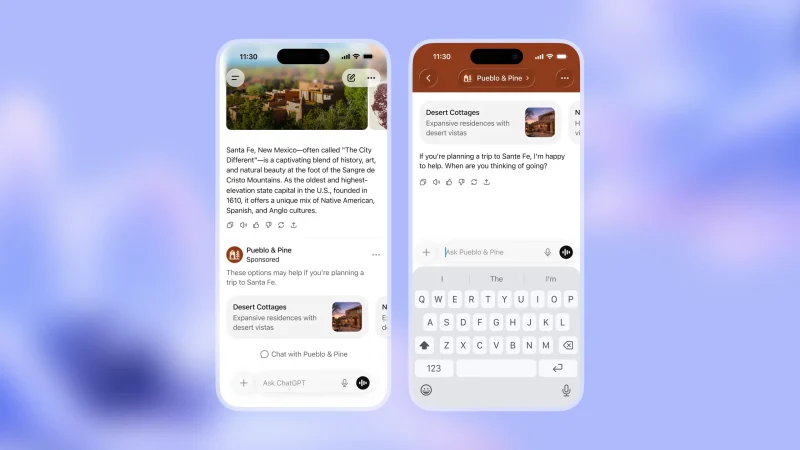
Also check whether they’ve got an opinion about where commerce is heading. Teams actually working in this space have views on how AI is reshaping ecommerce in 2026, on the Universal Commerce Protocol, and on what shopping inside ChatGPT means for their clients’ product data. Hype teams have slides.
Five questions that expose whether an agency’s AI claims are real
Run these in the pitch call. You don’t need a technical background to score the answers, because you’re listening for specificity, not for architecture.
- “Walk me through one task your AI does that your competitors do manually.” You want a single concrete task, named. If the answer covers three categories at once, press for one.
- “What data does it read?” Real systems read something: your Shopify order history, Klaviyo flow performance, Meta and Google reporting, margin by SKU. If nothing specific gets named, the tool isn’t connected to your business.
- “Who checks the output, and how often?” There should be a named role and a cadence. Senior strategist, every Monday, before budget shifts. No review step means nobody owns the result.
- “Show me a before-and-after from a client account.” Not a case study PDF. A screenshot, a workflow, a report. Agencies who built something want to show it.
- “What broke the last time you deployed it?” Everyone who ships automation has a failure story. An agency without one hasn’t shipped anything.
Score it simply. Three or more answers with real nouns in them, and you’re talking to a team that built something. Mostly adjectives, and you’re buying the same retainer you had last year with a new cover slide.
One more worth adding if SEO is in scope: ask how they think about getting a brand cited in LLM answers. The agencies paying attention have a point of view on LLM traffic share and on how ranking in ChatGPT actually works.
Red flags and green flags when you vet an agency’s AI claims
Patterns repeat across pitches. These are the ones worth memorizing before your next call.
Red flags:
- AI appears in the positioning but never in the scope of work. Check the proposal. If the deliverables list is identical to a 2018 retainer, the AI is decoration.
- Nobody can name the tools. “Proprietary technology” with no explanation usually means a ChatGPT subscription and a prompt library.
- Reporting still leads with impressions, reach, and blended ROAS. Vanity metrics survive because they’re easy to make look good. Ask what metrics they’d put in a quarterly business review instead.
- Headcount math doesn’t work. If a team of six services ninety accounts with no automation story, your account gets a junior and a template.
Green flags:
- They answer with constraints. Teams that know their systems know the limits of their systems.
- The senior person in the pitch is the senior person on the account. Ask directly who’s doing the thinking each week.
- Platform credentials check out. Meta, Google, Shopify Plus, and Klaviyo partner status is verifiable in a few minutes, and it tells you the platforms vouch for the work.
- They push back on something you said. Agencies protecting a sale agree with everything. That costs you later.
Keep the scoring honest by documenting answers while you’re on the call. Three agencies blur together by Friday, and the specific nouns are exactly what you’ll forget first.
Why Choose Wallaroo
We’re the AI-native agency for ecommerce, which means we pair senior human strategists with purpose-built AI agents instead of adding an AI line to a legacy process. We call it AI Commerce Architecture, and it covers paid media on Meta and Google, email and SMS in Klaviyo, SEO, and creative production.
We’ve served 200+ Shopify brands since 2007. We hold Meta, Google, Shopify Plus, and Klaviyo partner status; we’re an Inc. 5000 honoree; and we hold a 5.0 rating on Clutch. Those are the kinds of claims you can verify in about five minutes, which is the point.
Run the five questions on us. We’d rather answer them on a call than write another paragraph about why you should trust us. You can also read how we think about ecommerce growth on our blog and judge from there.
FAQs
How can I tell if an agency is actually using AI?
Ask the agency to name one task their AI performs, the data it reads, and who reviews the output. Specific answers with real nouns in them signal real systems. Answers made of adjectives signal marketing language. A team that built something will usually offer to show you a workflow or a report rather than describe it.
Is using ChatGPT the same as being an AI-native agency?
No. Using ChatGPT to draft copy is a productivity habit, available to anyone with a subscription. An AI-native agency has rebuilt its process so AI handles defined parts of research, analysis, creative iteration, and monitoring, with senior strategists making the decisions. The test is whether removing the AI would change their deliverables or only their typing speed.
What should I ask an agency about AI during the pitch?
Ask what their AI doesn’t do. The boundary tells you more than the capability list, because honest teams have a clear line between automated work and human judgment. Follow up by asking what broke the last time they deployed something. Anyone running automation at scale has a failure story ready.
Does AI replace the strategist on my Shopify account?
It shouldn’t. AI is good at volume work: generating variants, flagging anomalies, summarizing performance across platforms, pulling data together faster than a human can. Decisions about budget, offer, positioning, and creative direction need a senior person who understands your margins. Ask which human owns your account weekly, and whether that person is in the pitch.
Conclusion
Vetting an agency’s AI claims comes down to replacing adjectives with artifacts. Ask for one named task, the data behind it, the human who reviews it, and a failure story. Agencies that built something will answer in minutes. Agencies that bought a slide deck will change the subject to case studies.
If you’re evaluating agencies for your Shopify or Shopify Plus brand right now, bring the same five questions to us and see how our answers compare. Get in touch with our team and we’ll walk you through exactly how our AI Commerce Architecture would run on your account.