Why E-Commerce Brands That Aren’t Using AI Are Already Behind (2026)
Why E-Commerce Brands That Aren’t Using AI Are Already Behind (2026)
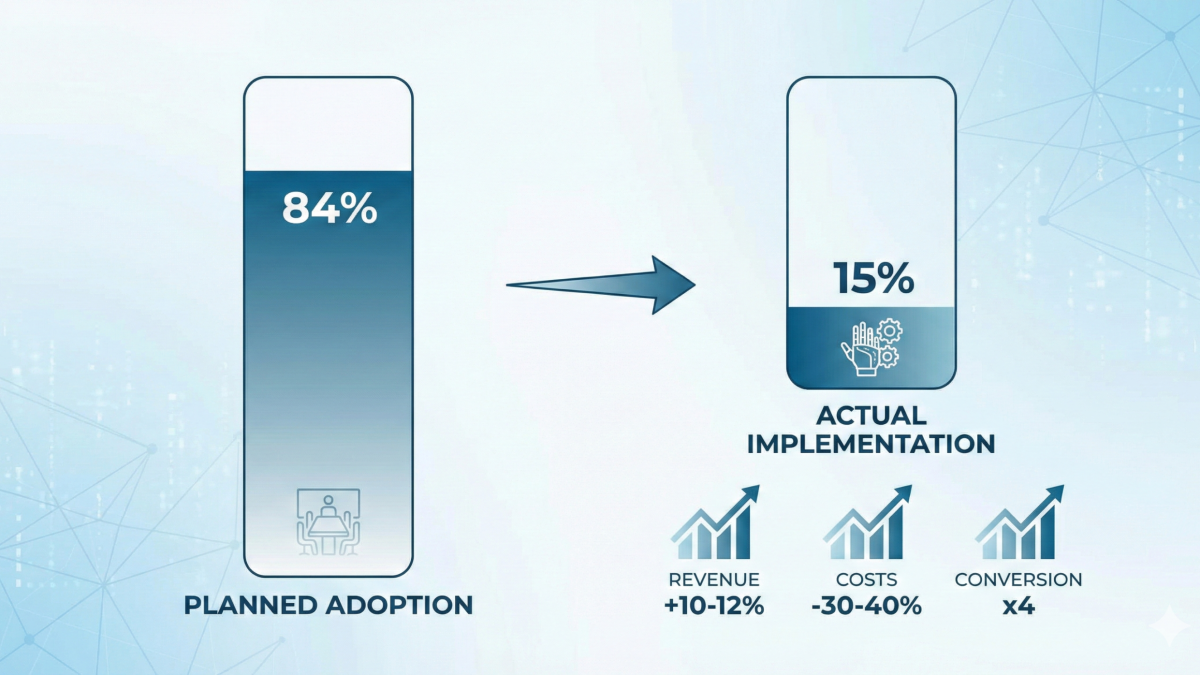
84% of e-commerce businesses are integrating AI. Here’s why the brands that wait will lose, and the 6 areas where AI delivers real ROI right now.
Most e-commerce brands say they’re “exploring AI.” That usually means someone on the team tested ChatGPT, the CEO asked about it in a meeting, and nothing happened.
Meanwhile, the brands actually using AI are seeing 10-12% revenue increases, cutting support costs by 30-40%, and converting at 4x the rate of competitors still doing everything manually.
This isn’t speculation. These are numbers from real implementations across real brands.
I’ve spent the last 18 months rebuilding our agency around AI—not as a buzzword, but as operational infrastructure. We use it across every client engagement. We’ve seen what works, what doesn’t, and what most people get wrong.
Here’s the honest case for why e-commerce brands need to adopt AI now…
The State of AI in E-Commerce Right Now

Let’s start with the data, because the adoption gap is wider than most people realize.
84% of e-commerce businesses are either actively integrating AI or have plans to. That sounds high—until you realize most of the “plans to” group hasn’t done anything yet.
Here’s what the companies actually doing it are seeing:
-
69% of retailers who implemented AI report revenue increases directly traceable to AI
-
72% experience cost reductions across operations
-
AI-assisted shoppers complete purchases 47% faster than unassisted ones
-
AI-driven personalization generates up to 31% of total revenue for brands using it well
The global AI-enabled e-commerce market hit $8.65 billion in 2025. It’s projected to reach $22.6 billion by 2032. By 2034? $64 billion.
This market isn’t “emerging” anymore. It’s here. The only question is whether you’re capturing any of it.
6 Areas Where AI Actually Changes E-Commerce
I’m not going to give you the generic “AI can help with personalization” advice you’ve read in 50 other articles. Instead, here are the six areas where we see AI delivering measurable results for e-commerce brands—with specifics on what that looks like.
1. Product Discovery and Search
Traditional e-commerce search is broken. A customer types “comfortable running shoes for flat feet” and gets 2,000 results sorted by “relevance” that isn’t relevant at all.
AI-powered search understands intent, not just keywords. It knows that “comfortable” means cushioning and support, that “flat feet” means specific arch types, and that the customer probably cares about price range even though they didn’t mention it.
This isn’t theoretical. We’ve written about how ChatGPT’s shopping update is reshaping discovery—users are already shopping through conversational AI instead of browsing your site. And with Google’s Universal Commerce Protocol enabling agentic shopping where AI agents complete entire purchases end-to-end, the brands with clean product data and AI-optimized catalogs get selected. Everyone else gets skipped.
The shift: You’re not just optimizing for human shoppers anymore. You’re optimizing for AI agents that evaluate your products against competitors in milliseconds.
2. Customer Support That Actually Scales
Here’s a number that should get your attention: AI chatbots deliver 148-340% ROI while reducing support costs by 30-40%.
But the bad chatbots—the ones that loop customers in circles and make them angrier—those are what most people think of. The difference is implementation.
Good AI support handles the 60-70% of tickets that are repetitive (order status, return process, sizing questions) and routes the complex stuff to humans. It doesn’t replace your support team. It removes the soul-crushing ticket volume so your team can focus on the interactions that actually build loyalty.
One pattern we see: brands that implement AI support well end up with higher customer satisfaction scores, not lower. Because the simple questions get answered instantly (no 24-hour wait), and the complex ones get more human attention.
3. Creative and Ad Production
This is where most agencies won’t tell you the truth, so I will.
We use AI across our agency—for ad hook generation, UGC-style content creation, competitor research, and creative iteration. Not because it replaces human creativity, but because it removes the bottleneck between “good idea” and “live ad.”
Before AI, producing 20 ad variations for testing took a week. Now it takes an afternoon. That’s not about quality shortcuts. It’s about testing velocity. The brand that tests 50 hooks per month will outperform the brand testing 5—every single time.
We’ve also covered the best AI tools for digital marketing if you want specifics on what we use and why.
The real advantage: Speed-to-insight. AI lets you learn faster what resonates with your audience, then double down on what works.
4. Personalization That Isn’t Creepy
Most “personalization” in e-commerce is terrible. “You looked at a blue shirt, here are 47 more blue shirts” is not personalization. It’s lazy retargeting.
Real AI-driven personalization means:
-
Dynamic product recommendations based on browsing behavior, purchase history, AND contextual signals (season, location, trending categories)
-
Personalized email flows where subject lines, product picks, and send times are all optimized per recipient
-
On-site experiences that adapt in real-time—different homepage for a first-time visitor vs. a returning customer vs. someone who abandoned cart yesterday
Brands doing this well see a 30% improvement in customer retention. Not because the AI is magic—because it’s doing what a great salesperson would do if they could remember every customer and their preferences.
5. Pricing and Inventory Optimization
This is the unsexy one that prints money.
AI-powered pricing tools analyze competitor pricing, demand signals, inventory levels, and margin targets to recommend optimal pricing—sometimes in real-time. For brands with hundreds or thousands of SKUs, doing this manually is impossible. Doing it with AI is table stakes for staying competitive.
Inventory forecasting is the same story. AI models predict demand patterns using historical sales, trending data, marketing calendar, and external signals (weather, cultural events, market trends). The result: less overstock, fewer stockouts, better cash flow.
Why this matters more in 2026: With agentic shopping making price comparison instant and frictionless, the brands with AI-optimized pricing don’t just compete better—they get selected more often by AI agents that are optimizing for the user’s total delivered cost.
6. SEO and Discoverability in the AI Era
Search isn’t just Google anymore. Customers are discovering products through ChatGPT, Gemini, Perplexity, and other LLMs. We track this closely—our LLM traffic market share data shows just how fast this shift is accelerating.
If your brand doesn’t show up when someone asks an AI “what are the best sustainable sneakers under $150,” you’re invisible to a growing segment of shoppers.
This requires a different approach than traditional SEO. We’ve laid it out in our comprehensive guide to LLMO and GEO—it’s about structured data, entity optimization, and building the kind of topical authority that LLMs reference when generating responses.
Bottom line: The brands investing in AI discoverability now are building moats that get harder to cross every month.
What Happens to Brands That Wait

I’ll be direct: the cost of inaction is higher than the cost of adoption.
Here’s what we’re seeing in real time:
-
The efficiency gap compounds. A brand using AI for creative production, customer support, and pricing optimization operates at fundamentally different unit economics than one doing everything manually. That gap widens every quarter.
-
Discovery shifts without you. As shopping moves to AI-mediated interfaces, brands that aren’t optimized for these channels don’t just lose share—they lose visibility entirely. You can’t compete for traffic you don’t know exists.
-
Talent expects it. The best marketers, operators, and strategists want to work with AI tools. If your stack is stuck in 2022, you’re not just losing customers—you’re losing the people who could help you win them.
-
Competitors aren’t waiting. 89% of retail and CPG companies are actively using or testing AI. If you’re in the 11% that isn’t, your competitors are learning what works while you’re still debating whether to start.
None of this means you need to overhaul everything overnight. But “we’ll get to it eventually” is not a strategy.
How to Actually Start (Without Overcomplicating It)

Most AI adoption fails because brands try to do everything at once. Don’t.
Phase 1: Quick Wins (First 30 Days)
Pick one area and prove value. The easiest starting points:
-
AI-powered customer support: Deploy a chatbot on your highest-volume ticket types (order status, returns). Measure deflection rate and CSAT.
-
Ad creative generation: Use AI to generate 10-20 ad hook variations for your next campaign. Test against your control. Measure CTR and CPA.
-
Product data cleanup: Use AI to audit and enrich your product catalog (better descriptions, complete specs, structured data). This pays dividends across every channel.
Don’t try to build a custom AI system. Start with existing tools. Prove ROI. Then expand.
Phase 2: Foundation (60-90 Days)
-
Implement product schema if you haven’t — this is the technical foundation for AI shopping and agentic commerce.
-
Set up AI-driven email personalization — Most ESPs (Klaviyo, Omnisend) now have AI features built in. Turn them on.
-
Start tracking AI-specific metrics — LLM referral traffic, chatbot resolution rate, AI-generated creative performance vs. human.
Phase 3: Competitive Advantage (90+ Days)
-
LLMO strategy — Optimize for discoverability across LLMs, not just Google.
-
AI-optimized pricing — Implement dynamic pricing tools for your top SKUs.
-
Agentic commerce readiness — Prepare for UCP integration as it rolls out to more platforms.
What We’re Doing at Wallaroo
We rebuilt our agency around this. Not because AI is trendy—because it’s better.
Every client engagement at Wallaroo now includes AI across the workflow. Our approach to AI integration isn’t about replacing our team—it’s about giving senior strategists the tools to move faster, test more, and spend their time on the work that actually drives results.
For our e-commerce clients specifically, we’re focused on:
-
Product feed optimization for AI shopping and agentic commerce
-
LLMO and GEO to capture discoverability across LLMs
-
AI-powered creative testing to find winning ads faster
-
Data infrastructure that makes everything above actually work
The brands we work with that have leaned into AI aren’t just keeping up. They’re pulling ahead.
The Bottom Line
AI in e-commerce isn’t a future trend. It’s the current operating environment. The data is clear: brands using AI are generating more revenue, operating more efficiently, and capturing new distribution channels that didn’t exist two years ago.
The brands that win in 2026 and beyond will be the ones that:
-
Adopt AI as infrastructure, not a side project
-
Optimize for AI-mediated discovery (LLMs, agentic shopping, conversational commerce)
-
Use AI to move faster, not to cut corners
-
Start now, even if imperfectly
The brands that wait will spend the next two years watching competitors figure out what they should have started learning today.
Your move.
FAQ
How much does it cost for an e-commerce brand to implement AI?
It ranges widely. You can start with existing tools (ChatGPT, Klaviyo’s AI features, free chatbot platforms) for near-zero additional cost. More advanced implementations—custom AI models, enterprise-grade personalization, dynamic pricing—can run $2,000-$10,000+/month depending on scale. Most e-commerce AI projects show initial ROI within 3-6 months.
Will AI replace my marketing team?
No. AI replaces tasks, not teams. The brands getting the best results use AI to handle repetitive work (ticket volume, ad variations, data analysis) so their people can focus on strategy, creative direction, and customer relationships. You’ll likely need fewer generalists and more people who know how to work with AI effectively.
What’s the biggest mistake e-commerce brands make with AI?
Trying to do everything at once. Pick one high-impact area, prove it works, then expand. The second biggest mistake: treating AI-generated output as final. AI gives you a starting point at 10x speed. Human judgment turns it into something that actually represents your brand.
How does AI affect SEO for e-commerce?
Significantly. Traditional SEO still matters, but a new layer—LLM optimization (LLMO) and Generative Engine Optimization (GEO)—is becoming critical. When customers ask AI assistants for product recommendations, your brand needs to be in those responses. This requires structured data, topical authority, and entity-based optimization.
Is it too late to start using AI for my e-commerce brand?
No, but the window for early-mover advantage is closing. 84% of e-commerce businesses are already integrating or planning to. The sooner you start, the sooner you build institutional knowledge around what works for your specific brand, audience, and product category.
Sources
About Wallaroo Media
Wallaroo Media is an AI-native digital marketing agency specializing in e-commerce growth. We combine senior-level expertise with AI-powered efficiency to help brands scale faster—from SEO and paid ads to LLMO and emerging channels like agentic commerce.
Want to transform your eCommerce brand? Contact us today!