What Changed for Shopify Brands in Summer 2026: AI Overviews, Agentic Checkout, and Where the Clicks Went
If your Shopify brand’s organic traffic looked strange this summer, it wasn’t your imagination. Between May and August 2026, three things shifted at once: Google put AI Overviews on roughly half of all searches, published its first official playbook for showing up in them, and — together with OpenAI, Perplexity, and Shopify itself — moved agent-driven checkout from demo to production. Here’s what actually changed, and what to do about it before Q4.
1. AI Overviews stopped being an experiment
AI Overviews now appear on roughly 47–64% of Google searches, and about 58% of searches end without a click to any website. For commercial research queries — “best running shoes for flat feet,” “klaviyo agency for supplement brands” — coverage is even higher.
The number that matters, though, is this one: brands cited inside an AI Overview earn about 35% more clicks, and only around 38% of cited pages rank in the traditional top 10. Read that again — most citations don’t go to the #1 blue link. The answer engine assembles its response from whatever sources answer the question most cleanly, wherever they rank.
For a $1M–$30M Shopify brand, that’s the whole game changing in your favor. You were never going to outrank Amazon or Healthline. You can absolutely out-answer them on the specific questions your buyers ask.
2. Google finally published the rules
In May, Google released its official AI optimization guidance — the first time it has said, in plain language, how its AI features choose sources. The short version:
- There is no special AI markup. No secret tag, no “AI-optimized” rewrite, and no, Google does not read llms.txt. AI features use the same index and the same snippets as regular search.
- Passages beat pages. AI Mode splits one question into a dozen sub-queries (a process called query fan-out) and pulls answers passage by passage. Every clear heading, FAQ answer, comparison table, and stat-bearing paragraph on your site is its own chance to be cited.
- People-first content, real point of view, real authors. Google explicitly warns against chasing “inauthentic mentions” and against over-engineering structured data. What it rewards is content a human expert would stand behind, with a name on it.
That last point is why you’ll start seeing actual humans on this blog — myself included — instead of a brand byline. AI systems weigh who wrote something, what they run, and whether they exist outside the article.
3. Agentic checkout went from demo to default-setting
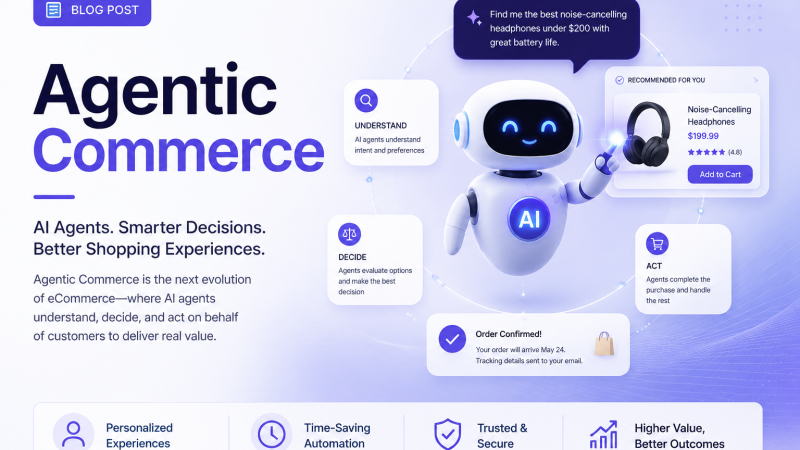
We wrote in January that agentic commerce was here. Summer made it operational: ChatGPT completes purchases inside the conversation, Google’s AI Mode carries a checkout path, and Shopify’s agent integrations mean an AI can browse, compare, and buy from your catalog without a human ever seeing your homepage.
When an agent shops, three things decide whether you win the sale:
- Machine-readable product data. Clean structured data, accurate feeds, current Merchant Center listings. Agents don’t squint at your hero image; they parse your data layer.
- Third-party reputation. Agents cross-check claims against reviews, editorial mentions, and community threads before recommending. Your Reddit presence and review velocity are now merchandising.
- Answerable policies. Shipping, returns, guarantees — stated plainly enough that an agent can quote them. “See our FAQ” is not an answer an agent can act on.
4. Where the clicks actually went
Zero-click doesn’t mean zero-influence. The research consensus this year is blunt: about 84% of the sources AI engines cite are earned, third-party media — editorial coverage, reviews, comparison lists, forums — not brand websites. Brands with active third-party trust signals show up in roughly 75% of relevant AI answers; brands without them, almost never.
So the traffic didn’t vanish. It rerouted through a reputation layer most brands have never managed deliberately. The playbook that wins the next twelve months looks less like classic SEO and more like this: be the clearest answer on your own site, and be verifiably praised everywhere else.
What to do before Q4
- Audit what AI already says about you. Ask ChatGPT, Perplexity, and Google AI Mode who you are, what you sell, and whether they’d recommend you. That’s your baseline — most brands are shocked by it.
- Restructure key pages for fan-out. Pricing, shipping, comparisons, use-case fit — each as a discrete, quotable section with a clear heading. One page per question you want to win.
- Put real names on your content. Author pages, roles, credentials. It compounds with every post.
- Feed the reputation layer. Review velocity on the platforms your category trusts, plus genuine participation where your buyers compare notes. This is what agents read before they recommend.
- Get your product data agent-ready. Structured data that matches the visible page, feeds that match inventory, policies stated in full sentences.
- Measure citations, not just rankings. Track whether — and how — you appear in AI answers monthly. It’s the new share of voice.
This is exactly the work our AI-Powered SEO practice does for Shopify brands — and the fastest way to see where you stand is a free AI Brand Audit. Thirty minutes, your actual data, no pitch deck.